Friday, December 16, 2011

AnomaLOLcaris

For the last few years, cats have been talking on the internet. I am referring to the prevalence of lolcats on the internet. For those who are not familiar with lolcats, here is a definition from the icanhascheezburger.com website: "a Lolcat is a funny pic of a cat paired with a caption (usually in lolspeak) that makes you lol! It’s pronounced as LOL-cat. Lolspeak is a language built on bad grammar, and Internet slang. For example: 'omg, uz don know lolspeak? srsly!!!1?'
At this point you are probably wondering what a blog about invertebrate fossils has to do with captioned photos of cats. Well, the idea of lolcats has spread to other animals, and following a recent article in Nature, the lolcat idea has spread all the way back to the Burgess Shale. Ed Yong, a science writer in London, has made an AnomaLOLcaris.  
For those who may have a hard time reading lolspeak, this anomalocaridid is saying, "I am in your Burgess Shale, confusing your scientists." This refers to the history of the discoveries and reconstruction of Anomalocaris. Initially, the forward appendages were described as Anomalocaris - "strange shrimp" - because they were never found with heads. A round 'jellyfish'-like specimen was described as Peytoia. It wasn't until 1979 that the 'shrimp' were recognized as appendages in a paper by Derek Briggs (Palaeontology. v. 22, part 3; pp.631-664. "Anomalocaris, the largest known Cambrian arthropod"). In a 1985 paper entitled, "The largest Cambrian animal, Anomalocaris, Burgess Shale, British Columbia," (Phil. Trans. R. Soc. Lond. B v.309, pp. 569-609) Dr. Briggs and his colleague, Dr. Harry Whittington, redescribe Anomalocaris as a swimming arthropod with shrimp-like appendages at the front, and a round disc-like mouth ("Peytoia").
"Peytoia" YPM 5825

Anomalocaris YPM 35138


Thursday, October 13, 2011

National Fossil Day 2011

My apologies for being behind the times! It seems that National Fossil Day always falls on a Wednesday, so if you celebrated yesterday, good for you! If (like me) you missed it, go ahead and celebrate today - the fossils won't mind. Honestly, what's an extra day when you've been dead for four hundred million years?
 Here's the link to this year's winning entries in the National Park Service's art contest. And here's my favorite from the drawings:
This year's theme was "Fossils in my backyard." This lovely drawing was done by Daniel, a 12 year old from Sharon, WI. I especially love the corals encrusting the letters - very nice!

And for my mollusk-loving friends, check out the honorable mention in the 19 and up category (courtesy of H. Sherrie Shepherd in North Little Rock, AR:


Thursday, August 25, 2011

Bivalves vs. Brachiopods: External differences

This may not be as exciting a post as the one about the internal differences between these two groups, but it has lots of useful tips for any budding paleontologists who want to know if they've found a brachiopod or a bivalve.

All in all, this comes down to symmetry. If you hold a brachiopod in your hand so that you are only looking at one valve of the shell, and then you flip it over to look at the other valve of the shell, you'll notice they aren't the same. Do the same thing with a bivalve, and you'll notice they are. If you were to look at the two valves of a bivalve shell you would see that they are, in fact, mirror images of each other (with a few exceptions, most notably the oysters). This means that the plane of symmetry in a bivalve runs right along the hinge line.

For brachiopods, it's the opposite. The plane of symmetry in brachiopods runs perpendicular to the hinge line; if you cut a brachiopod in half perpendicular to the hinge line, you would see that both halves are mirror images of each other! Cool, huh?

Wednesday, July 20, 2011

Ships that pass in the night

Work has been a little busy lately, and so I haven't gotten around to the external morphological differences of brachiopods and bivalves yet. For that, I apologize. In the meantime, here are some interesting tidbits quoted in Gould and Calloway's 1980 paper "Clams and brachiopods - ships that pass in the night" (published in Paleobiology v.6, no.4):
Louis Agassiz writes in 1857, "Every zoologist acknowledges the inferiority of the Bryozoa and the Brachiopods when compared with the Lamellibranchiata..." I disagree with Mr. Agassiz, but at least he quantified his statement. He is speaking of zoologists, people who deal in the present. In the present, bivalves (lamellibranchs) are much more common fixtures of the marine realm than brachiopods.
100 years later, Ernst Mayr writes, "Our knowledge of comparative physiology is still so elementary that we do not know, for instance, whether or not the cellular biochemical pathways of the mollusks give them superiority over the brachiopods, as one might suspect from a study of the geological record of these phyla."
What these two scientists fail to realize, and what Gould and Calloway so eloquently point out, is that the bivalves and brachiopods coexisted for quite some time. A major reason the bivalves seem to dominate the Mesozoic and Cenozoic is that the brachiopods took a major hit during the Permian-Triassic extinction. The reasons for this are unclear, but it was this disappearance of brachiopods and opening of new niches that allowed the bivalves to flourish as they did.

Friday, July 8, 2011

Brachiopods versus Bivalves

This one's for you, Dan!

What are the differences between brachiopods and bivalves, and how do you tell them apart?
The first thing one might notice if looking at them from a taxonomic viewpoint is that they belong in different phyla. Brachiopods are in the phylum Brachiopoda while bivalves are in the phylum Mollusca. This means that bivalves are related to the other molluscs (snails, cuttlefish, squids, nautiloids, octopus, etc.) while brachiopods are related to... brachiopods.

So taxonomically things are looking pretty distinct. On to the insides!
Both brachiopods and bivalves have two major muscles within the shell to keep it closed. Brachiopods have what are called adductor muscles. These muscles contract to keep the two valves closed. Bivalves also have adductor muscles that contract to keep the valves closed. So why do I bring this up as a difference? Bivalves have a second structure that separates them from the brachiopods. This structure is a ligament that joins the valves dorsally. When the adductor muscles in a bivalve relax, the ligament forces the two valves (shells) open. This is why bivalve shells (of dead bivalves) are often found in a "butterfly pattern" where both valves have opened in a pattern reminiscent of butterfly wings.

Modiomorpha (bivalve) specimen from our collection

The absence of a ligament like this in brachiopods means that when brachiopod shells (of dead brachiopods) are found, both valves are often found closed up as though the animal were still alive.
Laqueus (brachiopod) specimen from our collection
Borrowed from Dr. Dirnberger's site


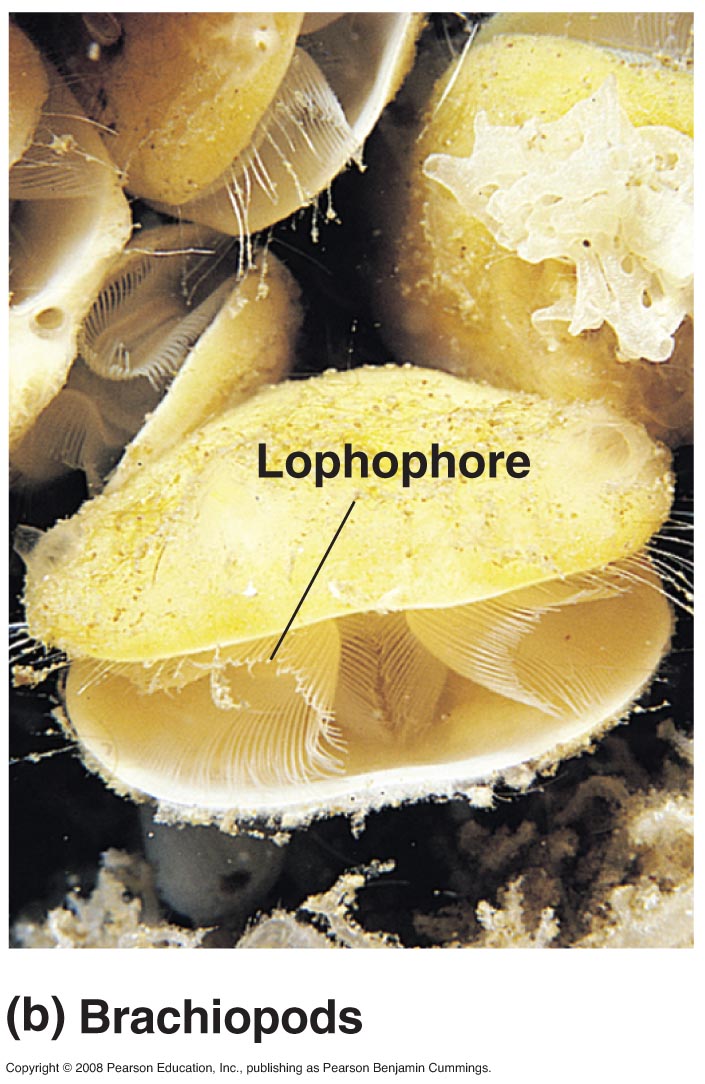
 Feeding systems are also completely different between the two groups. Brachiopods feed by means of a lophophore. This structure has a series of ciliated tentacles that can be extended to create a current which allows the brachiopod to catch food particles from seawater.


Bivalves, on the other hand, use an inhalant siphon to gather food. Some bivalves extend the tip of this siphon over the seafloor to search for food. Many others use the inhalant siphon to draw seawater into the shell. This water is then sieved by the ctenidia, and small food particles are collected. There is even a small group of bivalves (Poromyacea) that trap small worms and crustaceans in their mantle cavity to be digested! In this photo from Friday Harbor, WA the longer siphon is the inhalant siphon (the other is the exhalant siphon).
Borrowed from a Friday Harbor blog

Next week, external morphological differences!

Friday, June 10, 2011

Hunsrück Slate

The Hunsrück Slate might not be quite as famous as the Burgess Shale, but it is definitely a spectacular deposit. The area around Bundenbach, Germany sits on a famous lagerstätten known as the Hunsrück Slate. This deposit dates back to the Early Devonian, and it offers a partial glimpse of life at the time. The Hunsrück Slate is a slightly metamorphosed laminated mudstone. A diverse assemblage is preserved here with organisms ranging from echinoderms to small crustaceans to fish. Some of our most notable fossils from this assemblage include pyritized ophiuroids.
YPM 202621

The pyritized fossils from this unit were discovered as workers cleaved the slates apart for use on roofs. The pyritized fossils themselves are very rare, but when found are spectacular. The Hunsrück also preserves a number of well preserved fossils that are not pyritized. Most of the organisms were buried in place or transported short distances by density currents into shallow depressions on the seafloor.
YPM 792189

Friday, June 3, 2011

Federico Castelli

Federico Castelli
Doctor in Livorno, Italy.
b. ?, d. ?
His museum seems to have been dispersed around 1898, so that may have been the year he died.
Any additional information would be appreciated.